
Warning: you are entering re-charted territory.
The book you are holding in your hands is a map. We made this map together, assembled it from pieces stitched and woven, beaded and sequined with our stories, pieced together imperfectly where our edges found each other. On this map, what is marked as a monument may manifest as a statue, but might instead indicate an archive, a campus, or a land trust—collective interventions into the fraught territories of erasure and memory.
You might decide to forgo the map altogether and navigate by other senses. The sounds of a newly written poem recited aloud, muffled footsteps across the mesa, or the solemn cadence of children’s names. Or you could simply walk, or dance, until you find yourself in place. The music will be different in each locale, of course, but parts of the melody will feel familiar, and the steps will be easy to learn, because the steps for communal dances always are. On the balance, we suspect that dance is the best method for traversing this territory.
In each place you will be made welcome. In each place you will be a guest. Re:Generation is an initiative created to challenge the power of historical narrative and its concrete manifestations in monument, museum, archive, and land deed. Its ten projects, and the collaborations which produced them, engage deeply with Michel-Rolph Trouillot’s admonition that “to contribute to new knowledge and to add new significance, the narrator must both acknowledge and contradict the power embedded in previous understandings."1 As interventions into public memory and public history, the Re:Generation projects implicitly reject norms of power as best unspoken. They dismiss false virtues of empiricism and uncritical objectivity, of the narrator as unmarked, in favor of a full-throated embrace of the power of subjectivity. As projects, they are accountable to, and co-created with, those whose (his)stories they embody. This embrace is necessary. As social psychologist Mariluz Franco-Ortiz writes of Archivos del Caribe in this volume, these are projects “determined to create powerful, participatory, and liberating methodologies.” Subjectivity and mutuality are paths to unsettling power; they are essential to remembrance and repair.
If each of the Re:Generation projects were produced and consumed solely in the contexts of the communities that co-created them, their value would be immense. But as Trouillot reminds us, “The value of a historical product cannot be debated without taking into account both the context of its production and the context of its consumption.”2 We find ourselves, in the broader context of our current political moment, consuming historical production in a period of accelerating erasure. It is a revanchist moment eerily reminiscent of the late nineteenth and early twentieth centuries, when the Confederate Veterans’ History Committee and United Daughters of the Confederacy rewrote the legacies of the Civil War and Reconstruction and shaped curricula to ensure generations of ignorance and provide the intellectual underpinnings of Jim Crow authoritarian rule.3 They knew what we would do well to remember, that the work of producing history is the work of defining collective memory. As historian Thomas J. Adams writes in his introduction to this book’s chapter on Courage in the Hollers, “Memory is not passed down through genes or produced through some biological notion of culture or community. It is made and remade, unmade and suppressed by social processes.” The social processes of our moment are suspended in tension between racial reckoning and revanchist repression, in the possibility to either radically contract or expand our nation’s collective memory. That is the context of this production.
Re:Generation, as an initiative, is an intervention into collective memory by way of monumentality. The cohort of ten projects reflects a coalition of nearly eighty members who came together in monthly meetings, a summer of roundtable discussions, and in-person convenings. An effort to ensure that the production and consumption of their projects was not limited solely to the contexts of the communities that co-created them, but also found their places within this emerging community. In this coalition of remembrance, cohort members found parts of their own stories in each others’, often across unlikely lines of difference. They strategized together, cried together, celebrated together. They remade memory together. The territory of collective memory expanded to include new landmarks and way stations, in turn expanding the possibility of new cues, new guidance for navigating the present and shaping the future. In memory, we find the possibility of mobilization. In coalition, we find the best hope for achieving and sustaining the American promise of a true pluralistic democracy. When we can hold each other’s stories and honor each other’s histories, we can take inspiration from them to build not just a new national monument landscape but a stronger nation.
The ten Re:Generation projects transverse both past and present, “mobiliz[ing] the power in the story”4 to illuminate those purportedly different temporalities as inextricably entwined. In Queens, Tandang Sora traces bright lines from Melchora Aquino’s revolutionary nursing on the battlefields of the 1890s Spanish-held Philippines to overburdened care workers in pandemic-stricken New York City. The union partnerships and community solidarity of Courage in the Hollers connect the labor movement of 1920s West Virginia to the ongoing steel workers strike in Alabama, where The More Up Campus provides a site of convergence and conscience, holding the stories of medical torture enacted on enslaved women in 1840s Montgomery, as well as emerging horrors driven by the Supreme Court’s Dobbs decision in 2022 and its impact on the current crisis of maternal and infant death across the American South.
The threads of the respective projects weave across each other as well, connecting care labor and coal labor, the variable potential and precarity of federal recognition for Native tribes, and the profound importance of grandmothers, uncis, abuelas in holding our histories. Above all and at the root of everything, the Re:Generation teams’ projects underline the importance and promise of land. That is, land not in the sense of property which one might buy or sell, build on, or farm, but in the sense of place and the capacity of place to hold memory, to hold safe, hold sacred, to gather, to honor, to be where our roots are tied with others who share those ties and to invite in those with whom we wish to grow.
For the Land Under the Plinth and La Doce teams, the need to hold land took the form of community land trusts. In Los Angeles, Land Under the Plinth used their time as part of Re:Generation to reclaim and remediate the Tongva Taraxat Paxaavxa Conservancy, turning inward to build capacity, practice ceremony, and deepen community connections amongst the Tongva people, while turning outward to broader publics through banner drops and place markers that assert the persistence of ongoing land back efforts. La Doce, in Tucson, combined a learning fellowship grounded in the pragmatics of creating a land trust to protect their neighborhood from displacement with the co-creation of a community plaza and mosaic murals which create vibrant community space in response to much missed plazas of Central and South America and the Caribbean.
The Black HerStory Initiative in St. Louis and ConsenSIS in Philadelphia each came to Re:Generation with proposals for marking the stories of Black women and femmes on public land. Faced with challenges from permitting offices and other perennial features of civic bureaucracy, each team drew on the same lineages of tenacity, adaptability, and courage which they had intended to celebrate and as Black women do, because we must, made a way out of no way. For ConsenSIS, this meant claiming space emphatically, if ephemerally, at Awbury Arboretum and Johnson House, two historic sites in Philadelphia’s Germantown neighborhood, the latter of which has a history of providing refuge, with ties to the Underground Railroad. In St. Louis, Black HerStory Initiative anchor institution The Griot Museum, pivoted efforts and resources from wrestling with municipal leaders to invest in building out their own campus, a place for memory and community to be protected in physical as well as archival form.
In Rapid City, South Dakota, and the Four Corners Region, the Rapid City Indian Boarding School Lands Project and Walking with Dinétah took radically different approaches to bringing people back to the land, and ensuring the return of the land to the people. In Four Corners, Walking with Dinétah defined their relationship to the land through movement and memory. Partnering with the Dennehotso, Chilchinbeto, and Kayenta Chapters of the Navajo Nation to co-create Hózhó náhásdlíí’, or “walking in beauty,” their efforts quite literally tie story to place through embedded mnemonic installations and oral history collection. For the Rapid City Indian Boarding School Lands Project team, the Re:Generation period both catalyzed and coincided with ongoing efforts to redevelop the site of the long-shuttered school as a memorial to those who had died within it. Their work to hold land required navigating layers of government and private ownership at the scale of hundreds of acres of once promised property, and at the smallest and most profound scale, to ensure their right to a single brick wall where stolen children had inscribed their true names.
Despite their specificity and fidelity to community, culture, and place, or perhaps because of that very specificity, the ten Re:Generation projects speak in one chorus; they map one territory. In conversation, across geographies and generations, they conjure a counterfactual to the historical and monumental landscapes we have inherited and re-chart the territory of national memory, a memory which allows for mobilization and expands possibilities: The possibility of a nation in which reproductive autonomy means not just the right to bear our children with dignity and at a time of our choosing, but also to raise them safely to adulthood embraced in our own languages, cultures, and communities. The possibility of drawing strength and strategy from the history of labor to build a nation that honors the dignity of all workers. The possibility to be and stay in the places we call home, where we might dance together, remember together, walk the paths to where they converge, under the trees where our ancestors and anSISters gathered. If we are both fierce and fortunate enough to make our way across this re-charted territory, there is room for everyone to share the shade of those trees, to sit together, telling each other our stories.
About Monument Lab: Re:Generation
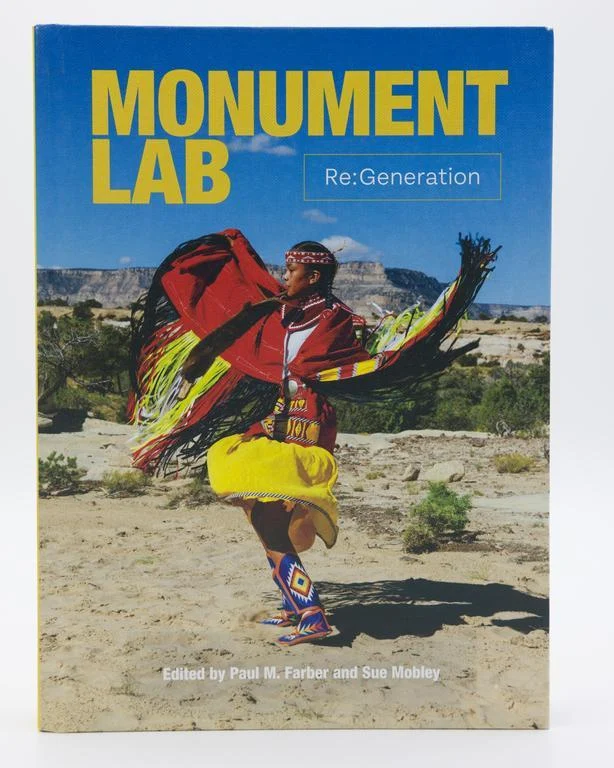
Monument Lab: Re:Generation presents case studies that travel across America, highlighting local commemorative campaigns dedicated to advancing public memory. Featuring articles and artwork from the country’s leading monument makers, each project includes a framing essay that provides insights into the varied contexts of location, culture, form, and subject matter.
Edited by Paul M. Farber and Sue Mobley