
This is a book about a house, in a city of row houses, at the faultline of democracy and belonging. A house in Old City Philadelphia that is remarkable and mundane, ordinary and uncanny. A symbol of birth and demolition. A site of freedom and enslavement. An artifact of authorship and erasure. Its dualities are overwhelming and grounding.
This book is also about the founding of the nation. It is about the radical potential and glaring inconsistencies of its originating document, the Declaration of Independence, as well as the protagonists of that moment, and the generations that carry its promise forward. A nation, to this day, still young in its fragile democracy and entrenched in its troubled histories. Traumatized, but also transformed by those who find pathways to healing, learning, and belonging.
The Declaration House, as we now understand it, sits on the historic location where Thomas Jefferson and Robert Hemmings spent several months in Philadelphia during the drafting of the Declaration of Independence in 1776. Jefferson, then thirty-three years old, was in Philadelphia, representing Virginia at the Second Continental Congress, where he served as principal author of the declaration. Hemmings, then fourteen years old, was the half brother of Jefferson’s wife, Martha Wayles Skelton. Hemmings was an enslaved valet brought to Philadelphia by Jefferson from his Monticello plantation in Charlottesville, Virginia.
From May to September 1776, Jefferson lived in a rented house at Seventh and Market Streets. There, early in the summer, he worked on the Declaration of Independence until it was approved by Congress. Delegates to the Second Continental Congress adopted the document on July 4 and signed it on August 2 at the nearby Pennsylvania State House (now Independence Hall). For the duration of their stay in Philadelphia, Hemmings attended to Jefferson, including taking care of his clothing, food, and personal matters. He likely slept in a hallway or attic on the upper level of the house.
The original Declaration House residence in which Jefferson and Hemmings stayed was owned by Jacob and Maria Graff, who operated brickyards in the city. Ownership of the house changed hands until 1883, when the structure was torn down. Other buildings that stood on this site included a bank designed by noted Philadelphia architect Frank Furness and a hot-dog stand named Tom Thumb. In 1975, in preparation for America’s bicentennial, the National Park Service’s Independence National Historical Park built a replica of the Graff House with an additional wing for exhibits and incorporated several fragments of the original house into its facade. While originally open to the public, in recent years the house has been closed in advance of renovations and efforts to increase accessibility.
The U.S. Declaration of Independence, drafted at this site, began the path toward freedom from British rule in thirteen American colonies and went on to have a profound and lasting influence on world history. The opening lines of the declaration—including the words “we hold these truths to be self-evi-
dent, that all men are created equal”—are so well known that it can be easy to forget how transformative they were as a statement of freedom. Since its writing, this document has inspired approximately 120 other “declarations of independence” by nations and peoples around the world. And yet these words were authored by a man who held others in bondage, even as he knew that slavery was a profound moral wrong. 1
The Declaration House holds the weight of our history, but as is often the case with historical sites and monuments, it obscures our understanding of a fuller narrative of the nation. The house stood on the outskirts of a colonial city that was lived in for more than ten thousand years by the Lenape peoples before it was founded. The name “Declaration House” was not part of its original imprint—it was a rental property, a colonial “Airbnb”—but its reemergence over the course of a century’s time following its demolition consolidates the history of the nation’s founding site into two words and one author of American democracy. Its most famous resident lived there only briefly, as a renter. The house stood on the edges of the city, and as the development of the colonial city moved west, it fell prey to its own form of gentrification. However, ifwe approach this site by locating Hemmings at this pivotal moment, we may tend to the haunts of history that also stand and speak here.
Jefferson’s “original Rough draught,” which was largely drafted at this site and shared with the Second Continental Congress on June 28, 1776, also included a later-deleted passage referring to slavery, in Jefferson’s words, as a “cruel war against human nature itself.” The full passage reads:
He [the King of England] has waged cruel war against human nature itself, violating its most sacred rights of life and liberty in the persons of a distant people who never offended him, captivating & carrying them
into slavery in another hemisphere, or to incur miserable death in their transportation thither. This piratical warfare, the opprobrium of INFIDEL Powers, is the warfare of the CHRISTIAN king of Great Britain. Determined to keep open a market where MEN should be bought & sold, he has prostituted his negative for suppressing every legislative attempt to prohibit or to restrain this execrable commerce. And that this assemblage of horrors might want no fact of distinguished die, he is now exciting those very people to rise in arms among us, and to purchase that liberty of which he has deprived them, by murdering the people on whom he also obtruded them: thus paying off former crimes committed against the LIBERTIES of one people, with crimes which he urges them to commit against the LIVES of another. 2
These are words the Second Continental Congress removed from the final version in the days leading up to July 4. This deleted passage is among the central contradictions that were not Jefferson’s alone to hold—they are also the contradictions that run under and through our nation today. They are part of an unreconciled past that continues to reinforce systems of injustice, haunt our present, and influence our individual and collective futures.
It is said that Jefferson sat silently as debate swirled among a group that included those who claimed ownership over other people and fought to remove this language. While you can read Jefferson’s original drafted words in esteemed locations such as the Library of Congress, the changes made in the declaration’s formation continue to inform our history today. While Jefferson’s words that “all men are created equal” constantly echo in the civic imagination of the United States, this deleted phrase conveying enslavement as a “cruel war against human nature itself ” remains elusive unless you know where to look.
This book aims to make room for a fuller history by revisiting the site of the Declaration House, mapping it onto the city and nation, past and present, as a way to tend to our democracy today. The mission of Monument Lab—to advance justice by reimagining monuments as places of learning, healing, and
belonging—led us here. The work of diving into the layered history of the Declaration House was a coalitional effort, and art remains at the core of this historical endeavor.
In 2022, Monument Lab began partnering with artist Sonya Clark, Independence National Historical Park, and later, the Thomas Jefferson Foundation, the nonprofit that owns and operates Monticello, as well as other civic partners, to produce a temporary, exterior-facing installation at Declaration House. Clark is a celebrated visual artist who summons historical reflection through participation and collaboration. Responding to the fact that there are no known historical images of Hemmings, Clark worked with the Thomas Jefferson Foundation’s Monticello and its Getting Word African American History Department to document the eyes of Hemmings’s collateral descendants and others who are related to the more than four hundred people enslaved at Monticello, including those biologically related to Jefferson.
In her resulting artwork, “The Descendants of Monticello,” Clark juxtaposed contemporary video portraits of the eyes of living descendants with eyes drawn from photographs of descendants in Monticello’s archives to form a multichannel video installation facing the intersection of Seventh and Market Streets. With this artwork, the historic house came to life through a monumental montage of blinking eyes that engaged passersby. Visitors to this temporary exterior installation were also invited to respond to the project’s central prompt—What does the Declaration of Independence mean to you today?—with hand-drawn responses at a Welcome Station in the courtyard of the house.
In the United States and beyond, the house is a significant container of history. House museums are prominent sites where we access, interpret, and embody the past. There are more than fifteen thousand house museums in the United States, including a number of prominent sites that conjure historic Philadelphia.3 Such houses are sites in which we are instructed, often from a young age, how to remember, who to remember, and how to balance the pride and pains of our past with a healing and hopeful sense of the future. Architects and preservationists approach this task in a number of ways. Some approach the exercise, as Svetlana Boym notes, as a “restorative” effort, with the goal of not only indexing the past but reenacting it. Others take the alternate “reflective” approach, accounting for gaps, fragments, and incomplete aspects.4
Monticello, the only house on a U.S. coin and Jefferson’s former plantation, is often seen—in the national imagination—as a city on a hill itself. Although construction of the neoclassical structure began in 1769, the house was not considered complete until 1809, although Jefferson never stopped refining the interior and exterior. Ultimately it was abandoned before being purchased and preserved by naval officer Uriah Levy and his family. But the preservation led by the Levy family is only a fragment of the story; the fact is, the majority of the inhabitants of this land were Black families who made an imprint on this space for generations. When it comes to Black history in the United States, the inequities of representation in the historic landscape are staggering. Of the ninety-five thousand sites listed on the National Register of Historic Places, only 2 percent focus on Black American life. This issue is not only empirical but one that speaks to the heart of the vexed relationship between public memory and citizenship in the United States, often played out through our monument landscape. It summons a reading not just of who and what is present in history’s often spotlighted narratives but of the absences and silences as intentional. In this book, we follow forebearers, including Danielle Allen, Annette Gordon-Reed, Nikole Hannah-Jones, Clint Smith, Lucia C. Stanton, and Salamishah Tillet, in their groundbreaking work with archives and historic fragments to recover the stories of enslaved people, including Hemmings, amid the histories of Jefferson and Monticello.5 We also are guided by Toni Morrison’s notion of literary archeology: “On the basis of some information and a little bit of guesswork, you journey to a site to see what remains were left behind and to reconstruct the world that these remains imply.” This “guesswork” or “rememory” involves honoring historical inquiry while bridging gaps with artistic acts of recovery.6
Hemmings embodies the dualities of this nation. He was born enslaved and later gained his freedom. The record of his life is scant, sifted through mountains of materials penned by Jefferson, although a record of his own hand appears in a relatively newfound archival record (which is discussed in Andrew M. Davenport’s essay “Robert Hemmings’s Declaration of Independence”). His family members—some of them well known, such as his sister Sally and his brothers Peter and James—have been the focus of historical debate, discovery, and discourse. Robert was not lost to history, to be clear, with prominent mentions in historical accounts of the Declaration House and Monticello. Still, he has been either a footnote in the stories of founding freedom in Philadelphia or absent from the narrative altogether. The Monument Lab installation at Declaration House, a form of reparative public art envisioned with Sonya Clark, steps in where prevailing methods of collecting, retaining, and commemorating history fail. “The Descendants of Monticello” mobilizes creative methods rooted in illuminating the lives and livingness of descendants to honor what we cannot know while attempting to recuperate stories ready to be told.
While historians have gone to extraordinary efforts to recover any trace of the lives, thoughts, and full humanity of enslaved people and their families, they still must contend with the gaps in the record and presentation. Even the Hemmingses, one of the most documented enslaved families in U.S. history, are recounted with a fraction of the documents and archival materials available for many other historical figures, which compounds the challenge faced in historical efforts to see the world through their eyes.
Declaration House is Monticello’s shadow house, a cipher in which to grapple with the origins and evolutions of U.S. democracy. Moving Robert Hemmings, as well as the many families and people enslaved at Monticello, to the center of this story reveals deeper insights into our still-emergent nation. In doing so, we are reminded of other under-spotlighted stories in Philadelphia, a birthplace of freedom and repression, abolition and dispossession. For example, just ten years before Jefferson’s and Hemmings’s time in the city, one in six Philadelphia homes housed at least one enslaved person. Likewise, outside those walls, free and enslaved people of African descent made homes, created networks of care and escape, and contended with the forces of repression in the cradle of liberty.
Jefferson is one of the most monumentalized figures in the U.S. commemorative landscape.7 Retelling the story of the Declaration of Independence with Robert Hemmings at its center does not threaten to erase these other, better-known histories. Rather, this project contributes to a richer history of the worlds these men inhabited and, consequently, a richer sense of the contingencies that shaped their actions.
As we enter our nation’s 250th year, the Declaration House project is a record of an experiment in its own right—to treat a historic site that was largely inactive as a space of vital and courageous storytelling, inspiring novel discussions centering healing, regeneration, and responsibility in the present. We also see this story, like that of our nation and its founding documents, as one that continues to echo—to demand persistence, attunement, and vigilance alongside ongoing, creative attempts at understanding.
This book gathers essays, poems, conversations, and artworks related to “The Descendants of Monticello” and the Declaration House project to assess and explore the Declaration of Independence, its authors, contributors, constituents, and all of us as works in progress. Whether you bring your copy with you on a trip to Independence National Historical Park in Philadelphia, consider it as an addendum to time spent at Monticello outside Charlottesville, or examine its ideas and artwork anywhere in the world, this book is about navigating geographies of freedom and belonging. We invite readers to consider Clark’s artwork and the written offerings in the book as lenses to at once access the past, grapple with the present, and reach toward a freer and more just future. We carry forward with these premises: The more we tell our full history as a country, the more we heal our wounds. The more we break patterns of generational harm. The more we chip away at gaps formed by history. The more we can innovate and live with one another with grace and with possibility.
We went looking for Robert Hemmings and found America.
About Declaration House
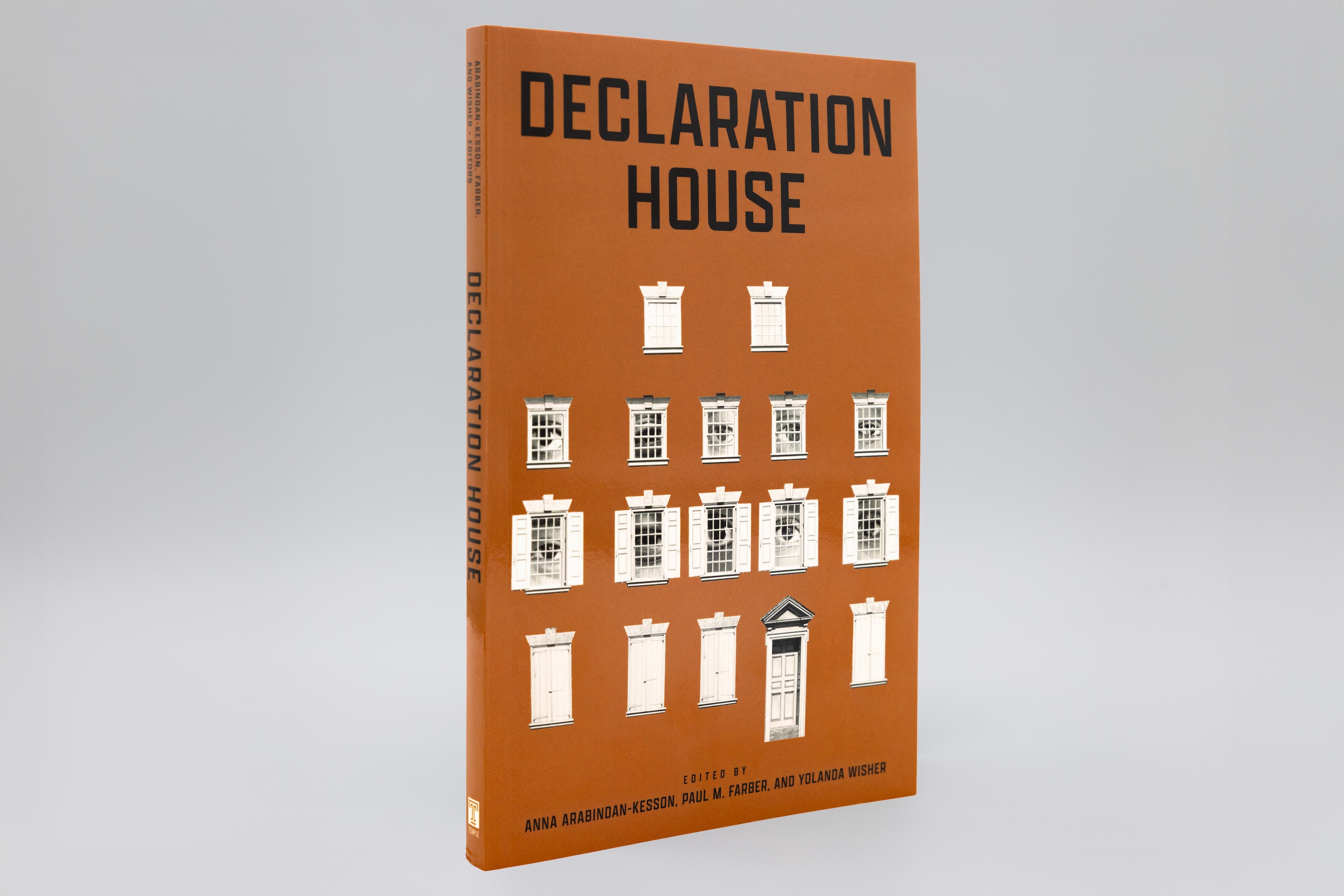
During the drafting of the Declaration of Independence in 1776, Thomas Jefferson and enslaved valet Robert Hemmings spent several months at 700 Market Street in Philadelphia. The editors and contributors to Declaration House reflect on the history of this site and illuminate the entangled legacy of freedom and enslavement at the core of our nation’s founding. They expand our history by revisiting and mapping this historic place in the city and nation, past and present, as a way to tend to our democracy today.
At the center of the book is artist Sonya Clark’s revelatory public artwork “The Descendants of Monticello,” a multichannel video installation created in collaboration with Hemmings’ collateral descendants and others who are related to the hundreds of people enslaved at Monticello. Interviews and essays about the project and the site consider history, memory, and the founding of our country. Like Clark’s project, Declaration House asks the timely question, "What does the Declaration of Independence mean to us today?"
Edited by Anna Arabindan-Kesson, Paul M. Farber, and Yolanda Wisher.
of Equality (New York: Liveright Publishing Corporation, 2015); Annette Gordon-Reed, The Hemingses of Monticello: An American Family (New York: Norton, 2008); Nikole Hannah-Jones, “Democracy,” in The 1619 Project: A New Origin Story, eds. Nikole Hannah-Jones, Caitlin Roper, Ilena Silverman, and Jake Silverstein (New York: One World, 2021); Clint Smith, How the Word Got Passed: A Reckoning with the History of Slavery across America (New York: Little, Brown, 2021); Lucia C. Stanton, “Those Who Labor for My Happiness”: Slavery at Thomas Jefferson’s Monticello (Charlottesville: University of Virginia, 2012); Salamishah Tillet, Sites of Slavery: Citizenship and Racial Democracy in the Post-Civil Rights Imagination(Durham, NC: Duke University Press, 2012).