
When I was a child growing up in New Orleans, my mother would always take my siblings and me to play at the playground at City Park. We often went on late Sunday afternoons, after church had been attended that morning and soccer games had been played midday. Sometimes we would go straight from the game to the park, our cleats singing a staccato song against the concrete sidewalk, our long socks still muddied from slide tackles and goal celebrations.
City Park has one of the largest collections of live oaks in the world. The branches of these centuries-old trees bent around each other like a congregation of dragons frozen mid-dance. Birds built their nests and laid their eggs. The pond where the ducks held court gleamed with streaks of orange-gold as the sun began descending into dusk.
Some of my fondest memories lie at the edge of this pond: screaming in delight as my brother, sister, and I chased each other around the slide; flinging my body from one monkey bar to the next to avoid the molten lava we imagined beneath us; thrusting my legs forward as forcefully as I could on the swing with the hope that it might propel me into space.
What’s striking about these memories at City Park is that one of the central images within it—alongside the monkey bars, the swings, and the slide—is a statue of P.G.T. Beauregard, a general in the Confederate army and the man who ordered the first shot that opened the Civil War. We played beneath his shadow, which moved like a sundial around us.
These sorts of monuments were for so long a ubiquitous feature of New Orleans. Statues of Robert E. Lee, Jefferson Davis, and a monument to an 1874 white supremacist insurrection were, until recently, prominent landmarks in my hometown. I think often about the juxtaposition of these statues with so much of what took place beneath them. How beneath the statue of Robert E. Lee, brass bands blared their horns as Black faces danced in a second line down the street. How beneath the statue of Jefferson Davis, Black children rode their bikes and laughed from the deepest parts of their bellies.
Those statues are gone now, necessarily so, taken down following the attack at Mother Emmanuel AME Church in Charleston, SC. Thanks to generations of activists they have been removed, and they have been reclaimed.
The Re:Generation project is one of reclamation. It is one that examines our collective landscape and imagines how we might be able to more effectively, more creatively, and more compassionately construct memorials that reflect the world we want to live in. How do we want to remember where we’ve come from? How do we imagine where we want to go? How can we build collective memory through our statues, through our language, through our bodies?
The organizations represented in the Re:Generation project are groups of people working to ensure that new generations of children grow up surrounded by iconography that doesn’t represent the worst of who we’ve been, but instead honors the best of who we can be when we account for the past with honesty and transparency. We are all better for their work.
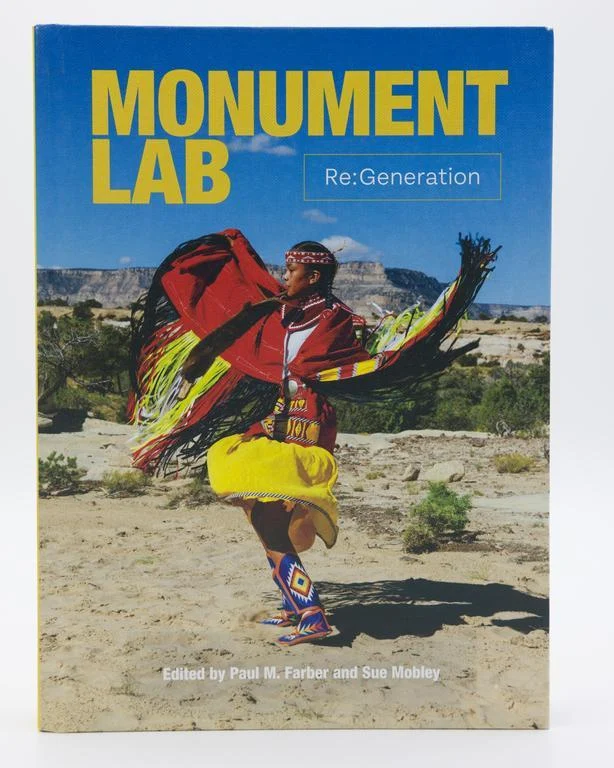
About Monument Lab: Re:Generation
Monument Lab: Re:Generation presents case studies that travel across America, highlighting local commemorative campaigns dedicated to advancing public memory. Featuring articles and artwork from the country’s leading monument makers, each project includes a framing essay that provides insights into the varied contexts of location, culture, form, and subject matter.
Edited by Paul M. Farber and Sue Mobley