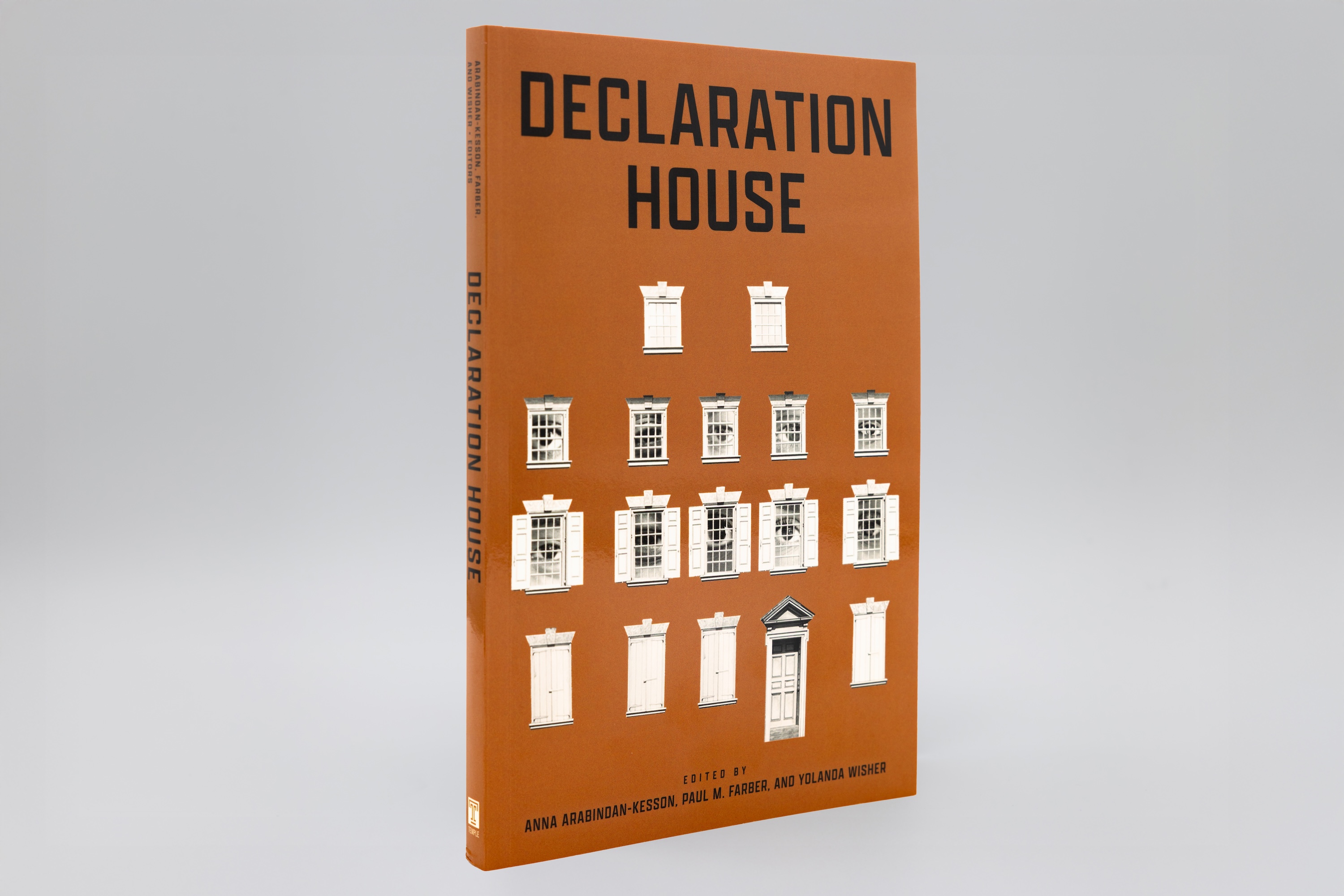
This conversation between Declaration House lead artist Sonya Clark and her close friend Gayle Jessup White, the Thomas Jefferson Foundation’s first public relations and community engagement officer, and the first descendant of Jefferson and the families he enslaved to work for the foundation, was recorded on Tuesday, December 19, 2024, on Zoom and moderated by Yolanda Wisher, senior curator at Monument Lab.
Yolanda Wisher: Can you begin by talking about the genesis of the Declaration House project?
Sonya Clark: My friend Gayle and I have been in conversation ever since we met. I can’t remember the first time, just that it was many, many years ago. And like anyone that you meet and then you feel like you’ve known them for a long time, I can’t actually remember the precise occasion that we met, because it felt like we already knew each other, and we had lots of things in common. We had D.C. in common, we had Richmond, Virginia, in common. We had many friends in common. And I also remember, Gayle, when you told me that you were one of the descendants of Sally Hemings. So, when Monument Lab and Paul Farber approached me and said, “Will you do something around Declaration House?,” and I had this concept around eyes, which we’ll get into, I just said, “I have to reach out to my friend Gayle.” And I remember Paul said to me, “Wait, is that the same Gayle Jessup White whose book I have sitting on our table in the office of Monument Lab?” And I said, “It is. And she’s fabulous.” And then I reached out to Gayle and asked her if she would do me the honor of connecting me with her family. Could we get into those family albums? And she said, “I can do you one better. Come on down to Monticello, and I’ll introduce you to the Getting Word African American History Department.” And so that was the beginning of this chapter.
Gayle Jessup White: We have come so full circle, and I’m honestly so moved by your comments. I have to tell you, Sonya, because your memories are very vivid, this is a significant day for me. I’m feeling a little emotional today. It’s my mom’s birthday. She would have been 106. You and I are both from D.C. It is as if we have known each other for so long. I know of your losses and when you lost your mother. And all these things build upon a friendship that will endure until we no longer endure on Earth. And so I treasure the conversation that we’re going to have now, even though I know we’ve got to talk about origins and what it means to participate in this kind of monumental turn in time. But more important is the friendship, and how we have come full circle, and how that book ended up on Paul’s desk, and how our husbands ended up meeting each other some twenty years ago, which is really what brought us together. It is a tapestry that we could not have anticipated, and only the ancestors could have done this for us. Only the ancestors could have made this happen.
SC: That’s right. I love that because it undoes this notion that somehow we did some stuff—and of course we did some stuff—but the “we” that did the stuff is filled with all of our ancestors. So, they’re in our hands, they’re in our bodies, and they’re the ones who are bringing us together and together again. So, when they say, “You’re going to meet Gayle, and you’re going to meet her husband, Jack, in Richmond, Virginia; you’re not going to remember when or why specifically, but we have some plans for you. You can’t see them yet, but we have some plans for you. And then you’re going to meet Paul Farber, and then you’re going to meet Yolanda Wisher, and then you’re going to meet Andrew Davenport. That’s right, trust us. We have some plans for you.”
GJW: So, they did it. And I’m grateful to them. When Sonya came and approached us with this project, I thought, “Oh yeah, of course, we would be thrilled to do this.” And Sonya mentioned the Getting Word team. We have at Monticello the Getting Word African American History Department. And she mentioned Dr. Andrew Davenport, who is my cousin, who is now the vice president for research and Saunders director of the Robert H. Smith International Center for Jefferson Studies, which oversees the Getting Word African American History Department. And they have now a team of young people who were so excited and enthused to get involved in this. Their office was right across from my office. And I went into their office and said, “I’ve got this great project, and I know you guys are overloaded, and I’m going to overload you some more because of this.” And then Sonya and her team came down. Sonya, Paul Farber . . . you came down, Yolanda. I mean, how many people? It was a party.
SC: Yeah. You gotta honor the ancestors with a big get-together.
GJW: And, of course, you all toured the house and toured, more importantly, the grounds. And there was a moment, Sonya, and I know you’ll recall this, when we were by a tree. Remember the tree there at Monticello?
SC: Oh, we can’t forget the tree. All of that ground is sacred space. It’s troubled space, but it’s also sacred space. Because of all the stories that are told and all the stories that come to light and all the whispering ancestors saying, “Pay attention to this. Pay attention to this.” I remember there was this tulip poplar tree that had been felled, and you could tell that it was quite a large tree because it hadn’t been uprooted, it had just been cut to a stump. What remained of the stump was quite impressive. We had a question about why was this large historical tree cut down. And it was cut down because it was leaning toward the “master’s house.” Right. So, as nature does, it had turned into a mother log and was growing another tree within it. Nature provides metaphors that words can’t properly hold. The tree within the felled tree stump had eyes. We knew the project was going to be about eyes. This inner tree surrounded by the mother log of the felled tulip poplar with its next generation within had naturally occurring eyes on its bark. Other trees nearby did as well. The skin-surface of these trees was watching us, witnessing us with those eyes, those trees. Their gaze held us in a moment of deep resonance, meaning, and contemplation.
GJW: It just happened that at that moment, the person who knew more about that tree than anyone else happened to be nearby. Her name is Debbie Donley, head flower gardener at Monticello. So, I walked over and said, “Debbie, what do you know about this tree?” And she said, “Everything.” And that’s how we learned about the tree. And that’s how we learned how the tree was able to regenerate itself. It was such a rewarding moment. And we were all touched by it.
YW: I want to talk about Robert Hemmings, who is at the center of this project and stands alongside Thomas Jefferson in our storytelling. We are centering Robert Hemmings in this project in a way that I don’t think he’s ever been centered before and, hopefully, will continue to be centered. Hopefully, this project is an opening into more investigation and interest in his life. What does Robert Hemmings mean to each of you? And when you look back over the story of his life, the details that we do know, what intrigues you the most or what haunts you about his story?
GJW: Robert Hemmings is my four-times great-uncle. One of his brothers, Peter Hemings, was my three-times great-grandfather. Robert was older. I often say, without the enslaved, there is no Jefferson. There is no Declaration of Independence as we know it, because he didn’t have to think about anything but writing. He didn’t have to think about what he was going to eat. He didn’t have to think about who was going to make up his bed. He didn’t have to think about who was going to empty his bedpan. He didn’t have to think about anything but thinking. That’s all he had to do. That is such a gift that enslaved people gave other human beings. And that’s the gift that we gave Jefferson. So, we have to thank Robert Hemmings for the declaration, not just Jefferson and John Jay and John Adams and Benjamin Franklin. No, we have to thank Robert Hemmings because he was there for every moment, every piece of paper that Jefferson might have thrown on the floor. He picked up every inkwell that had to be filled. He filled it. That’s huge. So, as a relative, a collateral descendant of Robert Hemmings, I’m really proud to know this history and to understand this history because we weren’t taught any of this growing up. Of course, I certainly wasn’t. I grew up in the sixties and seventies. I wasn’t taught any of this. I only learned this as a full-fledged grown-up. And it’s thrilling for me as a storyteller. And that’s what I consider myself above all else, a storyteller, able to share this history with other people and this greatness with other people. What haunts me about Robert Hemmings and all those who were enslaved is that they didn’t own their own personhood. What haunts me about Robert specifically is that he was actually sold by Jefferson to an émigré, a Frenchman who lived in Richmond. And Jefferson, also my ancestor, complained about having to sell him at a low cost. He felt he’d been cheated. And then after Robert was sold, he had to work off the fee. He had to work for his own person. That doesn’t just haunt me; it makes me angry. And at this point in my life, I’m really trying to diminish the anger as much as possible. But as I prepped for this interview and went back and read a little bit about Robert Hemmings’s history, I just started boiling all over. That, to me, is the greatest challenge about being Black, frankly, in the United States of America. Because no matter how successful I feel, there’s still that anger. There’s still that resentment. No matter how effective I think the storytelling is, I still feel that my ancestors, and as a result I, have been robbed of something. On the other hand, I also recognize the power, the dignity, the strength, the pride those ancestors had. And that balances it for me.
SC: First of all, I will say that anger is completely justified. And I feel that anger as a tool, actually. Because that fire in our bellies is what makes us say we have to tell these stories about injustice and unfreedoms and enslavement. There was paper provided. But we’re the ink, right? There really is no America without us. And when I hear you speak with such passion about the injustices of the past and the ongoing injustices in this nation, I am hearing your ancestors’ voices coming through you. I hear Robert Hemmings. I hear Sally [Hemmings]. I hear your mother, whose birthday it is today. All of your ancestors coming through you and saying, “What of our inheritance in this nation?” Through the act of colonization, the colonizer attempts to steal a person from themselves. They say, “You’re less than human. I’ve taken away your humanity, and what little remains, I’ve assigned it a value. But even that value is mine, not yours.” And that attempt to steal someone from themselves only serves to diminish the thief. It’s the thief who loses their soul in this equation. And so the anger also comes up in this notion of true soul recovery. Our ancestors, those who built this nation, are, in fact, the true soul of the nation. I think about how a range of emotions lives on from those who are ancestors, those who are present now, those who are yet to come. I actually said that in a very linear way, but I actually don’t think of it being linear like that. That soul recovery, you know, the fullness of who Hemmings was is coming to light now. I’d love to know more about the joyful experiences that he had. I also wonder about the conversations that happen between those who enslave and those who are enslaved and how many wisdoms are also stolen. This idea that the great white master is a deep thinker. I also wonder in the close proximity to the enslaved, how many ideas were stolen. You watch the grace of the person that you’ve enslaved. You watch how they take care of you. Maybe you’re watching or listening to something that they said and you say, “Oh, that’s useful too. And that is mine, because all of you belong to me as well. So all of your thoughts are also my thoughts.” We speak about culture vulture-ism, this way in which the colonizer, the oppressor, steals from those whom they’ve chosen to oppress. They say you have nothing. But at the same time, they’re taking everything and claiming it for themselves. I truly wonder about how much of this document [the Declaration of Independence] is inspired by us. And that’s a really hard thing to put one’s finger on. And we know that there are those lines that were taken out of the Declaration of Independence—that one pivotal point where Jefferson actually says, “Oh, wait, maybe slavery isn’t good.” And then that gets edited out, and you wonder, how did those lines get in there in the first place? We know how they were taken out, but how did they get there in the first place? I do think about stolen wisdoms and grace and joy and anger. And, of course, I’m always thinking, because of the nature of this project, about what Robert Hemmings witnessed, what he saw.
And I truly believe that what he saw is in the eyes of his descendants and collateral descendants as well, because as much as we are made up of those who have come before us, all their memories are also embodied in us. And so that collectivity of the things that I am seeing right now could be influenced by the genetic makeup of all those people who have come before me. It also works the other way as well, the epigenetics of it. What I see also shifts what my genes actually are. So, that’s what I’m talking about, this lack of linearity. By telling Robert Hemmings’s story, Sally Hemings’s story, the story of the descendants of Monticello as whole and as full as we can, we’re not only shifting the stories, but we’re also shifting our own genes for the next generation. And that’s powerful work to think about it in that way. And Robert Hemmings’s presence, his very presence has changed me and changed us. And I am, of course, no relation. But inasmuch as his story comes forth through you and your family, Gayle, then that shifts me genetically. And that’s how we’re connected.
GJW: That was actually poetic, beautiful, and inspiring. What Robert Hemmings and his siblings and the other enslaved people witnessed was the unfolding of democracy. What freedom could mean. They were listening. They were hearing. They were examples, you just mentioned, of what freedom was not, who certainly did influence Jefferson in the writing of the declaration. But in a linear way, Robert Hemmings, who had two children, and his siblings, who had many, passed those aspirations down. So that you have members of the Hemings family, all male, being emancipated by Jefferson in his will or during his lifetime. My ancestor was not. We have not figured out why. You have Jefferson’s children, because of the courage and the genius of Sally Hemings and their children, being emancipated or allowed to walk away. And then you have going into that same generation right before the Civil War, you have those people who were part of the Underground Railroad. You have conductors coming out of the Hemings family who were participants in the Underground Railroad because they were listening, they were hearing, they were inspired by what they were hearing, not just at the table of Jefferson’s. Because, remember, they were in that house listening all the time. And then you have ranking officers in the Civil War among Jefferson descendants and Hemings descendants. I say “Jefferson” because these are literally Jefferson and Sally Hemings descendants. And then you have Hemings descendants from other branches of the family.
So, it’s been linear from the time Robert Hemmings accompanied Jefferson to Philadelphia and became an instrument in helping him write that declaration to where we are today, to all of the work we’re doing at Monticello with Getting Word. The Getting Word African American History Department is part of that linear movement toward freedom and justice and equality for all. As far as all of us being ancestors or descendants, I tell people all the time when they visit Monticello that I have the gift of knowing on Dad’s side who my ancestors were, and those ancestors I share with everyone because we all have the same story. We all have people in our background who have the same battles and the same dignity, the same pride that they passed down. So, we are all connected. We’re all connected in that way. We’re all family.
SC: Well, it felt that way from the moment we met, so I know this to be true.You know how, when babies are born, and they can’t speak? I have this working theory that it’s because they know too much. So, they’ve got to keep them quiet for a little bit like that, and then they start speaking slowly. And then they start forgetting some things because they’re fresh genetic material, and they know too much. You know, you see a little baby, and you just say, this one looks like he’s been here before, right? Giving side-eye to the world. This one has a lot to say. And I’m thinking about how you’re talking about this very profound lineage of insistent freedom fighting. When I think about the ancestors, I don’t think about them as past. We’re in the present. And then there’s going to be these people coming in the future. I think about that as all one whole, a reframing of a Western way of thinking about how time works. So, if I’m embodying all of my ancestors, that means the past is with me in the present. And if I am to become a future ancestor—and for me, it would be collateral ancestors; I don’t have any kids—to other people, that means they are in me right now. Genetically, they’re in me right now. This framework collapses time in this way and makes it all present in the now. Which means that everything that we do in this moment is a responsibility to those who have come before us, who are embodied in us, and those who are yet to come, who are also embodied in us. And that’s why the work that is being done at Monticello and at the Getting Word African American History Department, the work that is being done unearthing stories and connections between people, is such important work. It takes the things that are in our subconscious or written genetically, and it brings it to our very present consciousness. That is deep, profound, and sacred work. And that is what I feel is the work of being an artist. It’s the work that I’m trying to do to be present and responsible to that action of embodying these ancestors and also embodying those who are yet
to come. So, what am I adding to this ancestral archive? Feeling their anger, doing something with it. Feeling their joy. Doing something with that. Feeling sorrow. Doing something with that. Feeling eloquence. Trying to do something with that. Feeling wisdom. Trying to do something with that. Feeling the sting of ignorance. Trying to undo something with that. All of those things.
YW: Sonya, you mentioned wanting to talk more about eyes, which are central to the symbolism of ancestors and Robert Hemmings’s presence. This is the material that you worked with to make this project happen. When you brought up the eyes, initially I started thinking about all the African American folk sayings that revolve around eyes, like “your eyes are bigger than your stomach,” or “eyes on the prize,” or “every closed eye ain’t sleep.” What do these eyes mean to you both culturally, symbolically, and genetically? And through this project, what do they come to symbolize for the public?
GJW: The eyes, from a descendant’s perspective, were important because they elevate who we are and who our ancestors were, and they force people to recognize what our contributions were, not just specifically of Robert Hemmings’s descendants, but who those descendants represent. And that would be all Black Americans. Those eyes signify that history. It’s an opportunity for people to think about what those eyes represent, and to go back and to learn all that history, because there’s so much there. They’re beautiful, they’re evocative, and they’re a trigger to help people think and to pursue knowledge.They are knowledge.
SC: When I think about this idea of using the eyes, of course, I was thinking about the genetic material. We don’t have images of Robert Hemmings because he was around in the late 1700s, and modern photography as we know it really began in the mid-1800s. But his eyes live on in his descendants and collateral descendants as his stories also lived on in those whom he told and how they imagined what he had seen. And so that, again, affects one genetically. We think about eyes as being windows to the soul. I don’t know who said this about the project, because now so many voices have been part of it, but someone was saying that this project is about the soul of America. The eyes being the windows of the soul, of the soul of an individual, but the multiplicity of eyes genetically being the windows to the soul of a nation. I’m thinking about my early studies in Yoruba culture. There are these crowns called adé ńlá, and they are covered with faces of ancestors. And the eyes are usually quite dominant, three-dimensional, and strikingly beaded black and white. And when royalty, the king or queen, is wearing this conical crown, they’re tethered to all of their ancestors. And it means that their physical human eyes have to be covered with this beaded net, because now they are superhuman. And I think about how in “The Descendants of Monticello” as a physical site–specific work, there is multiplicity of eyes larger than life in each of those windows. You couldn’t hold the bodies within the building if the bodies matched the size of those eyes. The space that we say is the site where the declaration, this document about freedom, was written is actually too small for us. Our people are bigger than that. Our people are bigger than what America thought about what freedom might be. We’re the water. We’re larger than that. I also think about the Ottoman Empire, Turkey, Greece, evil eyes. You’ve seen them, those blue eyes that are used to ward off evil. That in “The Descendants of Monticello” that watchfulness there is like this warding off of evil, like “I see you.” Not only am I seen larger than life, not in the shadows anymore, but also I see you, with all my folks, I see you. What is happening now? We have a fascist president soon to be in power who is a declared and confirmed white supremacist. We see you. I even think about in the late 1700s, just around the same time that Jefferson was drafting the Declaration of Independence, there were these brooches that European gentry would make for one another, and they were called Lover’s Eyes. So, people would wear these brooches, either of someone who was close to them or someone who had passed, as a memorial to the deceased or a token of a lover. They would commission someone to paint a very realistic version of that person’s eye, so that they could wear that eye on them and have that person close to them. But then the waters get troubled when you actually look at the material of those objects: They’re painted with watercolor on ivory, usually encased in gold with pearls. So, colonization, stealing, stealing, stealing resources and then putting the eye of your lover on that. And then finally, and I’ve said this several times, I think about ophanim in the Old Testament—this is something that one of my students shared with me. Ophanim are the multi-eyed angels that watch over us. I think about all of those things in the context of this project, and many of them came to me from conversations with other people. People say, “Oh, you had all of that artist intent.” And I think, no, I had a little bit of it, a seed. And then other people told me what they saw in the work. The work has the capaciousness to hold all of that in its blossom. I think about these beautiful moments when descendants from Monticello, these beautiful human beings, are standing before the work, seeing themselves in the project, embodying their ancestors. Like when you’re there, Gayle. When your family members and your cousins, like Andrew Davenport, are there, when you’re looking at this work, seeing yourself recognized. Now, I recognize these people too, as I see their eyes in the windows. Seeing yourself be seen. Seeing others see you. Witnessing your ancestors in your eyes, and just like that, this collapses this space and acknowledges the water that we are, essential, everywhere, cutting through the stone of history across time.
One other thing that was such a surprise to me in the artwork. Of course, we planned to use these big monitors in each of the windows of Declaration House to play the videos of the eyes. But when at night it became a lighthouse, a multi-eyed beacon, that was such a gift. As Earth turns away from the sun, the eyes of the descendants of Monticello light up Philadelphia. And the building, the Declaration House, falls away. The eyes are all you see. I didn’t plan that; that’s the serendipity. That’s when the artwork is so much larger than me, me as the artist being the vessel that the artwork came through. But, of course, as I always say, this project happened in deep, deep collaboration with Getting Word, with the descendants, with Monument Lab, with MING Media—and then, in collaboration with every single person who walked by those streets. I think about how if everything that we’ve seen in our entire lives is held in our consciousness and therefore written and rewritten in our genetic code, then that means that artwork has the capacity to do that too. Everyone who has witnessed this artwork has actually been changed by it on some level. That’s what we did together. We changed everybody who walked by. That’s the power that I’m talking about and it’s why artists must walk with responsibility.
YW: What makes this project monumental? Because y’all are from D.C., you know a thing or two about monuments and what it means to live among them. I also know this living in Philadelphia. Some of our most important, our country’s most important, monuments live in these places. “The Descendants of Monticello,” for me, is a new kind of monument and a very necessary one. What do “The Descendants of Monticello” and the Declaration House project add to the monument landscape in our country?
GJW: Our Black people, and women as well, have not been elevated as they should have as contributors to making America successful. And to me, this exhibition is alive. It’s not static. It’s not an equestrian or some big white man on a horse carrying a sword or looking down at Sacagawea, diminishing everyone but their own glory. That to me is really offensive. And I lived in Richmond when statues which were one hundred years old literally looked down on little Black boys and girls who really didn’t know what those statues were. I know this because I talked to people in Richmond who grew up among those statues. They had no idea what those statues were, but they knew they were big white men looking down upon them and belittling them. “The Descendants of Monticello” is not so much a monument as a celebration. It’s a celebration of who we are. It is alive. Those eyes are animated. Sonya pointed out that if you had a body attached to those eyes, it would be a colossus. It makes us as big as anyone who’s been celebrated in the United States of America. Do you know how big a colossus is? Maybe bigger. Like the Statue of Liberty. And every American should have the experience of seeing those eyes—those animated eyes holding history accountable and holding all of us accountable for each other—and recognizing not just what Robert Hemmings and his descendants have done but what we have done.
SC: Gayle, I’m thinking about what you’re saying about the Black and Brown children in Richmond walking by those monuments and thinking, “Those must be important people.” But I’m also thinking about the white children who were walking by those monuments in Richmond and thinking, “We must be very important.” And so I think about how white privilege and white supremacy doesn’t exist unless it has its foot on the neck of somebody else. It’s one thing to say, “We are,” as Black and Brown people. And it’s another thing for white folk to be like, “You know, we aren’t!” Like this idea that “I must be smart because I’m white, I deserve to be wealthy”—that actually has to be undone. People don’t relinquish power easily. The first time I heard someone say these words, it was you, Miss Yolanda Wisher: that Monument Lab defines a monument as “a statement of power and presence in public.” So, who’s in power, and who’s present, and who’s the public? And I love that definition because it does not talk to the supposed permanence of these Confederate statues that were erected. Some of them look like they’re made of solid metal, and they’re actually made cheaply and just seem large and impressive. You have to look up to them sitting on high plinths, right? Why does a monument require you to look up to it? Why is that how it’s deriving its power? With “The Descendants of Monticello,” what we were doing together is claiming power, making presence, and addressing the public. That was the assignment, and I think we did it.
I love these moments where you can tell when the eyes of the descendants are smiling. People are being human in their eyes. And all of that is held just on a large scale in the artwork. So much humanity is revealed in just this one part of the body, the eyes. And you think about how much of our bodies are denied. How much Black people are still policed for any little thing. We just recently said to Jordan Neely’s family, “Your troubled son who was in a New York subway could be killed by a white man. And that’s okay, because, you know, he was ‘disturbing the peace.’” These examples are endless, but it’s incredible how much policing there is around our bodies and yet how much humanity is expressed in just one single eye of each of the participants who were descendants of Monticello, who were part of this project, and how much humanity gets denied on a consistent level, and that this becomes this push-back, this resistance, this refusal to that denial as a monument, as a monument to freedom.
GJW: I was listening to everything you said, and it made me think of the day that all of you came with your team to Monticello to take the pictures of descendants and how excited everyone was and eager to participate. And the pride that we have in our ancestors and, to use your metaphor, how they have flowed through time with us and made us who we are. And I know that we’re down to the last of this conversation, but before we finish, I just want to thank both of you and all who participated in this and making this project and engaging us in this project and allowing us to embrace who we are and who our ancestors were. What’s so significant is that we love these people. Robert Hemmings is real for me. And Sally [Hemings]’s real. And Peter [Hemings]’s real. When I walk around Monticello, particularly when I’m in the space where James [Hemings] and Peter [Hemings] were, where they were cooking together, I feel them. They’re real. I’m working on a book about Mom’s family now, and I know these people. Mommy didn’t know at least one set of her grandparents. She didn’t know, but I know them.
SC: Oh, that’s so beautiful.
GJW: And it’s a remarkable journey. I’m just really pleased that I and my DNA cousins had a chance to bring these stories alive through your art, through the instrument of both of you, because we all made it possible. So, I just really appreciate it. And they appreciate it.
SC: It remains to date the piece that has changed me the most, and we, again, we did it together. There was an opportunity, and then we came together and realized that into something that honestly has changed me as the first public artwork I’ve ever made. Ever. And there was the trust that was required, shifts that were made, you know, because at first we were like, “Oh, we’ll just use the Hemmings line of descendants.” But just expanding that to include all the descendants of enslaved families at Monticello and feeling the power of the ancestors rush in, and we got that expanded feeling of love and camaraderie. Also, if someone asked me how many days we were at Monticello, I would answer, “Oh, I was there for months!” The kinship felt very real. And that’s love. That’s love and purposefulness. And that can only happen in true community. So, I’m really grateful to you. I’m going to start crying—but I’m really grateful.
YW: My last question stems from thinking about how much this project has been about ancestry, how much it’s influenced my thinking about my own ancestors and my reflections about them. I had originally wanted to ask you this question: “What kind of ancestor do you hope to be?” But because we are breaking the boundaries of time and linearity in this conversation, I’m asking y’all: “What kind of ancestor are you?” And what do you hope to do with your ancestor status?
SC: I mean, I’d like to think, as I said before, that I’m adding to the ancestral archive, that I’m not harming it in any way. The archive is rich and full and has the good, the bad, and the ugly in it. My intent is to add to it in the good ways, but I am human, so I may falter. I think it’s such a profound question that it’s the kind of question that you want to ask yourself every day. And I actually would like to ask it of the people who are reading this conversation, to just leave it at, like, “What kind of ancestor are you?” Provocative questions mean that we’re constantly in dialogue with the question, which means that we’re constantly shifting and reevaluating and thinking. For me, that’s also what the best artwork does. It doesn’t provide an answer. It gives you a question to keep, to stay by your side, to hold and guide you. This question is something that will stay by my side. It’s now going to be on my wall in my studio as this positive provocation of how to be in the world. So, I don’t have an answer—I have a guide. I feel like it’s a gift. And I’m just taking that gift in, receiving it, and doing my best by that gift.
GJW: I’m going to keep this really simple. This is Mom’s birthday. And usually I get through Mom’s birthday without shedding a tear. She was fabulous. She was kind of crazy, but she was fabulous—which you’ll read about in my second book. But I wept this morning. I wept and I wept and I wept, and I could not turn it off. Because today, I miss her. And when you write, it’s like—I mean, you guys are writers and artists, you know—you really get into these lives. In this case, it’s not a memoir. It’s about her. It’s about her dad. But there’s a lot of memory in it. I’m living her life over again. I’m living her. And when you ask what kind of ancestor I’d like to be, I just want to be. I want to be remembered the way my mom is remembered. I shared a picture of her with my girlfriends today. Mommy’s kicking her legs up on the hood of somebody’s car. I don’t recognize the car or the people. She was maybe in her sixties, seventies. I’m looking at how she looks. I mean, she wasn’t young—maybe my age, I don’t know—but she’s just leaning back on the car, kicking her legs up and laughing, and the guys are looking at her and laughing, and I’m thinking, “What a hoot.” She was totally uninhibited. But if I can be remembered by the people who loved me, I’m happy. That’s all the ancestor I need to be.
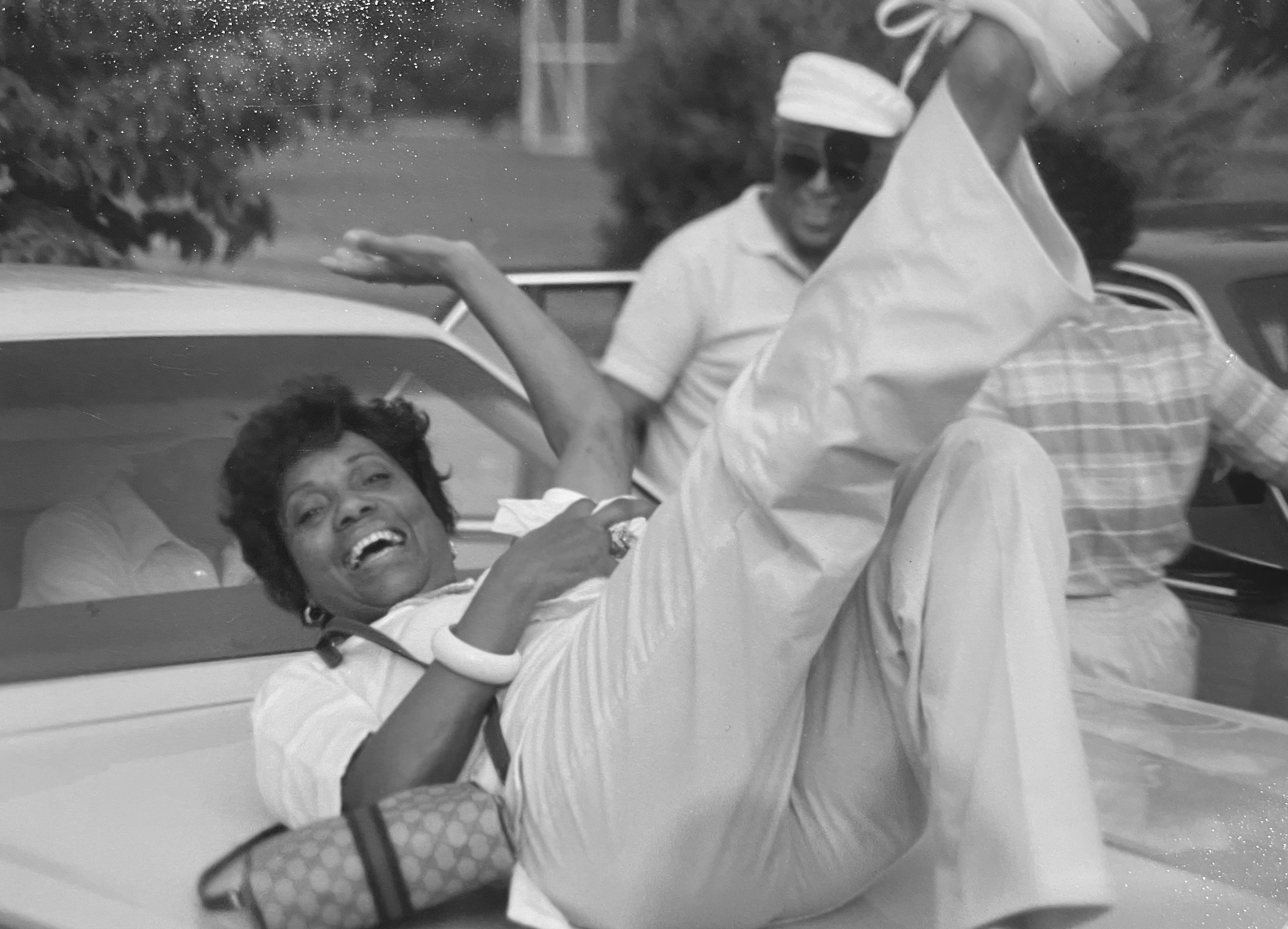
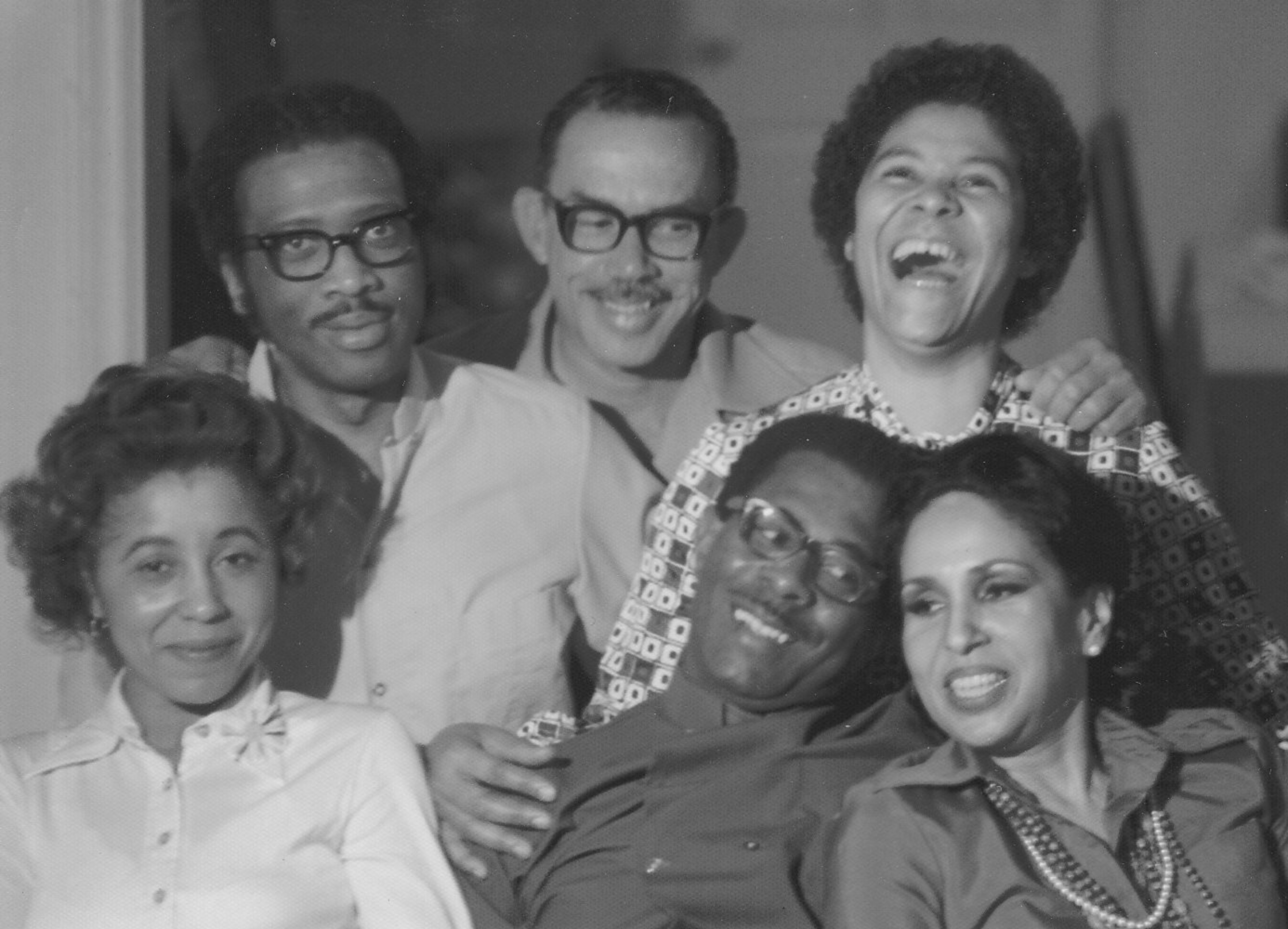
SC: So, first of all, you do make people happy. You’re always funny. We’re talking about some serious shit, and you’re still funny. You still bring joy. And I love that about you. I also am thinking about how free your mother sounds like she was. The image that I have in my head is of her taking space. Yes, the legs up, and like that Nina Simone quote, “I’ll tell you what freedom is to me: No fear!” So, the ancestor that I am, I hope, is someone who is free. Just working on freedom and taking this space of being free. And your image of your mother reminded me of my favorite image of my mother. Well, I have two, but this one in particular, when my mother was with her friends. She was probably a little younger than I am now. She was probably in her forties, early fifties, and she has her mouth wide open, her head tossed back, and she is laughing so hard that whenever I see the picture, I hear her laugh. She’s so joyful and free and filled with being loved. That’s what makes us keep going, right? I can see your mother, Gayle. I know she was cute. Mine was too and a character too.
GJW: I can imagine.
SC: But I love that because they were the fullness of themselves. My mom did not take any shit from anybody. And she would decide if she liked you in the first two seconds of meeting you. And good luck crossing from one side to the other, because if she decided she didn’t like you, that’s that. And if she liked you, she fiercely held you tight. So, it sounds like they were so much themselves. And that’s a kind of freedom, despite everything else. May we continue in this reclamation of freedom.
GJW: I love that. I love that. I love that freedom that they experienced and the reclamation of that. That’s what we all need. That’s where we’re all going.
About Declaration House
During the drafting of the Declaration of Independence in 1776, Thomas Jefferson and enslaved valet Robert Hemmings spent several months at 700 Market Street in Philadelphia. The editors and contributors to Declaration House reflect on the history of this site and illuminate the entangled legacy of freedom and enslavement at the core of our nation’s founding. They expand our history by revisiting and mapping this historic place in the city and nation, past and present, as a way to tend to our democracy today.
At the center of the book is artist Sonya Clark’s revelatory public artwork “The Descendants of Monticello,” a multichannel video installation created in collaboration with Hemmings’ collateral descendants and others who are related to the hundreds of people enslaved at Monticello. Interviews and essays about the project and the site consider history, memory, and the founding of our country. Like Clark’s project, Declaration House asks the timely question, "What does the Declaration of Independence mean to us today?"
Edited by Anna Arabindan-Kesson, Paul M. Farber, and Yolanda Wisher.